
The CALM Framework
A Structured Approach to De-escalation

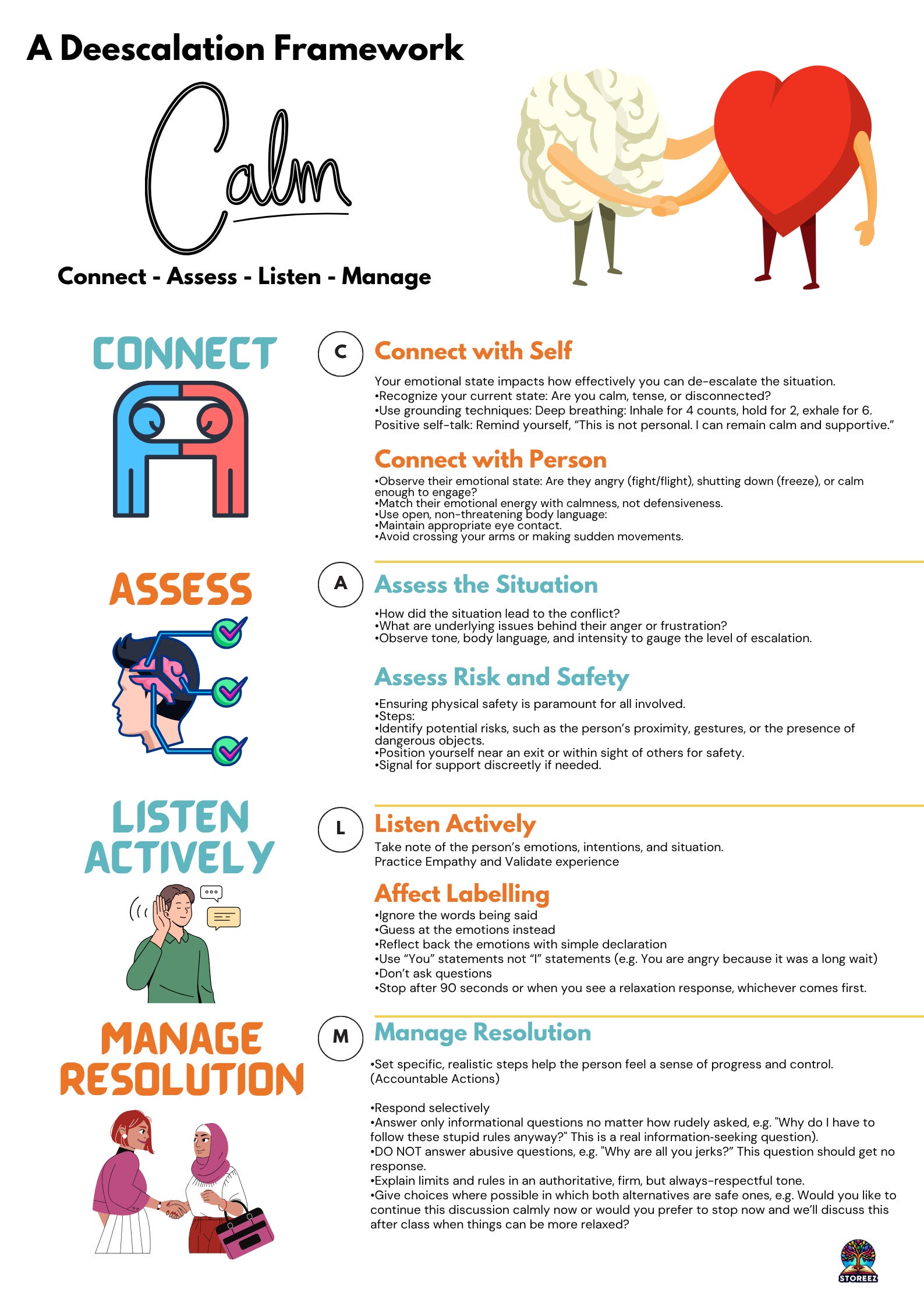
In social work, community engagement, and even our everyday interactions, we sometimes face conversations that escalate, where voices get louder, emotions surge, and safety can feel uncertain. The question is: how do we keep the situation from boiling over, while still honouring the dignity of the person in front of us?
One approach I’ve found both practical and deeply human is the CALM framework. It’s not about “winning” an argument or silencing someone, it’s about restoring safety, connection, and constructive dialogue.
C – Connect
The first connection is with yourself.
When tension rises, your nervous system reacts before your logic catches up. Drawing from Polyvagal Theory, pause to notice: Are you in the calm ventral vagal state, the tense fight/flight sympathetic state, or the shut-down dorsal vagal state?
Use grounding tools such as deep breathing, positive self-talk (“This is not personal”), and an open, non-threatening posture, to bring yourself into a place of steadiness.
Then, connect with the other person.
Empathy and attunement lower emotional intensity. Observe: Are they angry, withdrawn, or open to engagement? Match their energy with calmness, not defensiveness. Simple, reflective statements like, “It sounds like you’re frustrated about how things have unfolded” show that you’re listening and that their feelings matter.
A – Assess
This is where you take stock of safety for both you and the other person.
It includes physical, emotional and psychological safety. Notice the environment: Is there enough space? Are you positioned in a way that allows both connection and an exit if necessary?
Assessment also involves reading cues: tone of voice, body language, and underlying emotions. The Window of Tolerance reminds us that reasoning is only possible when a person is within their optimal arousal zone. If they’re outside that window, the first step is to help bring them back in.
L – Listen Actively
This is more than hearing words, it is about emotional listening.
We often underestimate how powerful it is to name and validate emotions. Affect labelling (“You sound worried about what will happen next”) can quickly reduce physiological arousal. It does not mean you agree, it means you recognise their emotional reality.
The opposite would be emotional invalidation (“You’re overreacting” or “Calm down”). This not only fails to soothe but can escalate conflict. Active listening communicates, “I see you, I hear you, and I’m taking you seriously.”
M – Manage the Resolution
De-escalation isn’t the same as problem-solving.
You cannot work toward solutions if the person remains in a heightened emotional state. Once calmer, shift towards constructive next steps:
Clarify what can be done immediately.
Be honest about limits—avoid over-promising.
Collaboratively agree on an accountable action plan: who will do what, by when, and what the follow-up will be.
Here, you move from “putting out the fire” to ensuring the embers don’t reignite.
The CALM framework blends neuroscience, communication skills, and human dignity. By regulating ourselves first, we become the steady presence the situation needs. By assessing, listening, and managing, we move from chaos to clarity.
In my experience, CALM is not just for crisis moments—it’s a way of being. Whether in a tense client interaction, a heated workplace meeting, or a family disagreement, these four steps help us keep compassion at the centre and re-open the possibility for change.